

Why Mortgages Need Smarter Tech: A Note From My First Month at Balerion
Date
Date
Author
Bahador Saket, Founding Product Lead, Balerion
Author
Bahador Saket, Founding Product Lead, Balerion

After almost a month at Balerion, one thing has become very clear to me:
Mortgage does not have a document extraction problem.
It has an understanding problem.
Finding a number on a bank statement is one thing. Understanding what that number means across hundreds of pages, multiple guidelines, lender overlays, and the full context of the borrower is something entirely different.
That is where the process still breaks down. Files reach underwriting with missing information, conflicting numbers, and issues that should have been caught earlier. Underwriters are left hunting for problems instead of making decisions.
Companies have spent years trying to fix this. So why does the same pain still exist, and why do I believe the technology finally exists to solve it differently?
The Problem
When someone applies for a home loan, the file passes through many hands. A loan officer collects documents, a processor checks them, and an underwriter reviews everything. That includes income, assets, employment, credit, and supporting documentation that can run hundreds or even thousands of pages.
A lot of these files are messy. Information is missing. Numbers do not match. Documents are incomplete.
When a messy file reaches an underwriter, the underwriter has to stop and ask questions. The loan officer or processor goes back to the borrower. Everyone waits, and the file eventually comes around again.
This can happen repeatedly. It slows the process and wastes underwriters’ time on hunting for problems instead of making decisions.
Technology should identify these issues earlier, before a loan ever reaches an underwriter. A cleaner, more complete file moves faster through the entire pipeline.
This is not about saving a few minutes.
It is about removing work that never needed to happen.
Extraction Is Only the Beginning
Before joining Balerion, I understood that mortgage involved a huge volume of documents. What has become even clearer during my first month is that extracting information from those documents is only the first step.
What you do with that data, and how you use it to support a real decision, is the actual hard part.
Understanding a loan file means picking up on nuance scattered across documents, guidelines, lender overlays, and sometimes even inside an experienced underwriter’s head. The challenge is pulling all that information together, making sense of it, and reaching a conclusion that is trustworthy, interpretable, and defensible.
That difference between extracting information and actually understanding it is central to what we are building at Balerion.
Why Rules Alone Aren’t Enough
Many companies have tried to solve this problem before. Most relied heavily on rule engines. They wrote one rule for this scenario, another rule for that scenario, and continued adding rules in an effort to cover every possibility.
Hardcoded rules still have an important role, especially when a calculation or requirement has one correct answer. But rules alone struggle with the complexity of mortgage guidelines, loan programs, lender overlays, and edge cases.
For years, rule-based systems were one of the only tools available. Traditional software could pull text from a document, but it could not interpret a complex guideline or reason across an entire loan file.
That has changed.
Today’s AI models can read long, messy documents, interpret context, and reason across multiple pieces of information. This is a new capability, not simply a faster version of the old one.
At Balerion, we are building agentic systems that can interpret and apply conforming guidelines, non-QM requirements, and lender-specific overlays directly from source documents.
These agents can review a loan file, work through the applicable guidelines, and generate the appropriate checks. They can flag what appears to be wrong, explain why, and suggest a path to resolution. Each finding can be traced back to the specific guideline and document field that informed it.
Working with our partners and customers, we have evaluated this technology across 20,000 real historical loan files. In one example, the system reviewed a 1,023-page loan file in under four minutes, achieving more than 99% extraction accuracy across over 1,132 fields.
But the goal is not to use AI everywhere. The real product challenge is knowing where each type of technology, and each person, belongs.
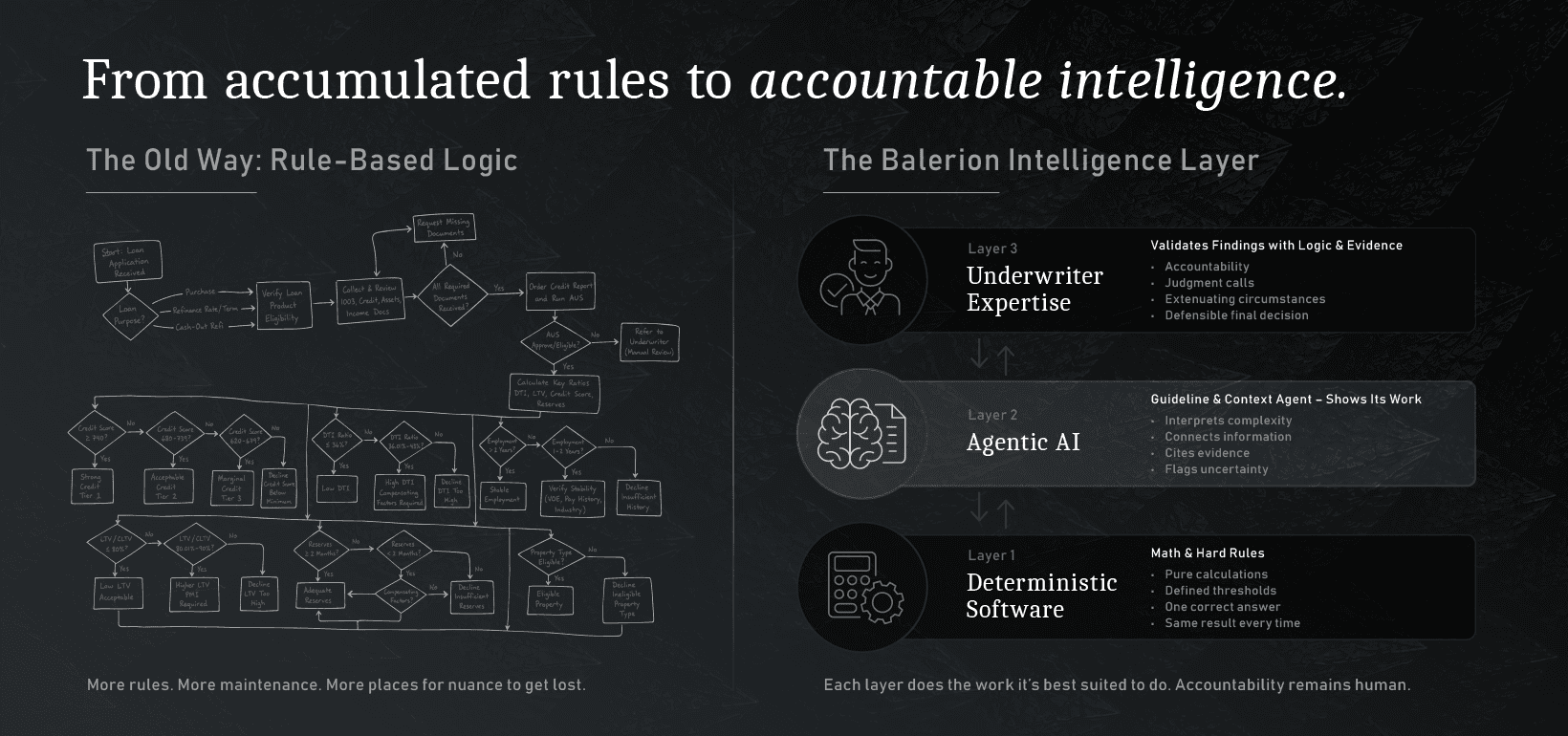
Where Rules, AI, and Human Judgment Belong
I think about the loan review process as three different types of work.
Anything involving pure math or a hard rule should be handled deterministically. Calculating debt-to-income ratio or checking whether a deposit crosses a defined threshold does not require AI. There is one correct answer, and it should be the same every time.
Then there is a middle layer where AI actually helps. This includes reading messy documents, identifying a type of income, connecting information across a file, or matching a borrower’s circumstances to the right guideline.
AI can reason through that complexity, but it needs to operate within clear guardrails. It should show its work, cite the information behind its conclusion, and flag when it is not confident instead of guessing.
Finally, there are real judgment calls. Extenuating circumstances following a bankruptcy or an unusual self-employed income pattern may not have a simple answer. AI can help by gathering the evidence, identifying the relevant guidelines, and laying out the case. But an experienced mortgage professional should make the final decision.
The real question is not simply, "Can AI do this?"
It is: Who needs to be accountable if this is wrong?
That question helps determine whether something should be handled by deterministic software, AI operating within guardrails, or a human with the experience and authority to make the final call.
Technology Has to Fit the Work
Before mortgage, I built technology for legal professionals and doctors. The lesson that has carried through every industry is the same: you cannot ask an expert to completely change how they work just to use your tool.
Whether someone is a lawyer, a doctor, or an underwriter, the technology has to fit naturally into the steps that already exist. It cannot force a new process on top of a job that already carries significant complexity and risk.
It also has to be explainable, not just fast.
An underwriter is not going to trust a conclusion without seeing the reasoning behind it. The technology needs to show which document, number, or rule led to the finding, just as an expert would be expected to explain their own work.
The product should not ask mortgage professionals to blindly trust the technology. It should give them the evidence and context they need to verify and act on what it finds.
Why I Joined Balerion
Three things made joining Balerion an easy decision for me.
First, the timing feels right. Mortgage technology has struggled with many of the same problems for decades. With where AI and machine learning are today, this feels like an opportunity to solve the underlying problem, not just chip away at it.
Second, the team. I get to work with great engineers I have built things with before, including people from my time at Ponder. We already know how to work together and how to turn sophisticated technology into products people can actually use.
The biggest reason, honestly, is that I get to build something from the ground up with founders who are not only incredibly sharp, but also close friends I trust completely.
That combination does not come around often, and I was not going to pass it up.
What I Want to Build Next
Balerion is not trying to make an old process a little faster. We are moving intelligence earlier so problems can be identified and resolved before they create delays downstream.
What I am most excited about is the day Balerion can help take a loan from start to finish in just a few clicks. From the moment a borrower starts searching for a loan through the point when that loan is sold to an investor, I want the entire journey to feel more connected.
That is the version of this I want to help build toward. Not another isolated tool that automates one step, but an intelligent platform that improves the process from end to end.
Doing that well requires more than powerful models. It requires strong evaluations, clear guardrails, traceable findings, and constant feedback from the people who understand mortgage best.
There is still a lot for me to learn and a lot for us to build.
That is exactly what makes this problem worth solving.
After almost a month at Balerion, one thing has become very clear to me:
Mortgage does not have a document extraction problem.
It has an understanding problem.
Finding a number on a bank statement is one thing. Understanding what that number means across hundreds of pages, multiple guidelines, lender overlays, and the full context of the borrower is something entirely different.
That is where the process still breaks down. Files reach underwriting with missing information, conflicting numbers, and issues that should have been caught earlier. Underwriters are left hunting for problems instead of making decisions.
Companies have spent years trying to fix this. So why does the same pain still exist, and why do I believe the technology finally exists to solve it differently?
The Problem
When someone applies for a home loan, the file passes through many hands. A loan officer collects documents, a processor checks them, and an underwriter reviews everything. That includes income, assets, employment, credit, and supporting documentation that can run hundreds or even thousands of pages.
A lot of these files are messy. Information is missing. Numbers do not match. Documents are incomplete.
When a messy file reaches an underwriter, the underwriter has to stop and ask questions. The loan officer or processor goes back to the borrower. Everyone waits, and the file eventually comes around again.
This can happen repeatedly. It slows the process and wastes underwriters’ time on hunting for problems instead of making decisions.
Technology should identify these issues earlier, before a loan ever reaches an underwriter. A cleaner, more complete file moves faster through the entire pipeline.
This is not about saving a few minutes.
It is about removing work that never needed to happen.
Extraction Is Only the Beginning
Before joining Balerion, I understood that mortgage involved a huge volume of documents. What has become even clearer during my first month is that extracting information from those documents is only the first step.
What you do with that data, and how you use it to support a real decision, is the actual hard part.
Understanding a loan file means picking up on nuance scattered across documents, guidelines, lender overlays, and sometimes even inside an experienced underwriter’s head. The challenge is pulling all that information together, making sense of it, and reaching a conclusion that is trustworthy, interpretable, and defensible.
That difference between extracting information and actually understanding it is central to what we are building at Balerion.
Why Rules Alone Aren’t Enough
Many companies have tried to solve this problem before. Most relied heavily on rule engines. They wrote one rule for this scenario, another rule for that scenario, and continued adding rules in an effort to cover every possibility.
Hardcoded rules still have an important role, especially when a calculation or requirement has one correct answer. But rules alone struggle with the complexity of mortgage guidelines, loan programs, lender overlays, and edge cases.
For years, rule-based systems were one of the only tools available. Traditional software could pull text from a document, but it could not interpret a complex guideline or reason across an entire loan file.
That has changed.
Today’s AI models can read long, messy documents, interpret context, and reason across multiple pieces of information. This is a new capability, not simply a faster version of the old one.
At Balerion, we are building agentic systems that can interpret and apply conforming guidelines, non-QM requirements, and lender-specific overlays directly from source documents.
These agents can review a loan file, work through the applicable guidelines, and generate the appropriate checks. They can flag what appears to be wrong, explain why, and suggest a path to resolution. Each finding can be traced back to the specific guideline and document field that informed it.
Working with our partners and customers, we have evaluated this technology across 20,000 real historical loan files. In one example, the system reviewed a 1,023-page loan file in under four minutes, achieving more than 99% extraction accuracy across over 1,132 fields.
But the goal is not to use AI everywhere. The real product challenge is knowing where each type of technology, and each person, belongs.
Where Rules, AI, and Human Judgment Belong
I think about the loan review process as three different types of work.
Anything involving pure math or a hard rule should be handled deterministically. Calculating debt-to-income ratio or checking whether a deposit crosses a defined threshold does not require AI. There is one correct answer, and it should be the same every time.
Then there is a middle layer where AI actually helps. This includes reading messy documents, identifying a type of income, connecting information across a file, or matching a borrower’s circumstances to the right guideline.
AI can reason through that complexity, but it needs to operate within clear guardrails. It should show its work, cite the information behind its conclusion, and flag when it is not confident instead of guessing.
Finally, there are real judgment calls. Extenuating circumstances following a bankruptcy or an unusual self-employed income pattern may not have a simple answer. AI can help by gathering the evidence, identifying the relevant guidelines, and laying out the case. But an experienced mortgage professional should make the final decision.
The real question is not simply, "Can AI do this?"
It is: Who needs to be accountable if this is wrong?
That question helps determine whether something should be handled by deterministic software, AI operating within guardrails, or a human with the experience and authority to make the final call.
Technology Has to Fit the Work
Before mortgage, I built technology for legal professionals and doctors. The lesson that has carried through every industry is the same: you cannot ask an expert to completely change how they work just to use your tool.
Whether someone is a lawyer, a doctor, or an underwriter, the technology has to fit naturally into the steps that already exist. It cannot force a new process on top of a job that already carries significant complexity and risk.
It also has to be explainable, not just fast.
An underwriter is not going to trust a conclusion without seeing the reasoning behind it. The technology needs to show which document, number, or rule led to the finding, just as an expert would be expected to explain their own work.
The product should not ask mortgage professionals to blindly trust the technology. It should give them the evidence and context they need to verify and act on what it finds.
Why I Joined Balerion
Three things made joining Balerion an easy decision for me.
First, the timing feels right. Mortgage technology has struggled with many of the same problems for decades. With where AI and machine learning are today, this feels like an opportunity to solve the underlying problem, not just chip away at it.
Second, the team. I get to work with great engineers I have built things with before, including people from my time at Ponder. We already know how to work together and how to turn sophisticated technology into products people can actually use.
The biggest reason, honestly, is that I get to build something from the ground up with founders who are not only incredibly sharp, but also close friends I trust completely.
That combination does not come around often, and I was not going to pass it up.
What I Want to Build Next
Balerion is not trying to make an old process a little faster. We are moving intelligence earlier so problems can be identified and resolved before they create delays downstream.
What I am most excited about is the day Balerion can help take a loan from start to finish in just a few clicks. From the moment a borrower starts searching for a loan through the point when that loan is sold to an investor, I want the entire journey to feel more connected.
That is the version of this I want to help build toward. Not another isolated tool that automates one step, but an intelligent platform that improves the process from end to end.
Doing that well requires more than powerful models. It requires strong evaluations, clear guardrails, traceable findings, and constant feedback from the people who understand mortgage best.
There is still a lot for me to learn and a lot for us to build.
That is exactly what makes this problem worth solving.



See Balerion in action
Request a demo

© 2026 Balerion AI
See Balerion in action
Request a demo
© 2026 Balerion AI
See Balerion in action
Request a demo
© 2026 Balerion AI
See Balerion in action
Request a demo
© 2026 Balerion AI