

What I’m Hearing About the Next Chapter of Mortgage Intelligence


Some of the most useful conversations I have about mortgage technology don’t happen in product meetings. They happen with lenders and people who have spent decades in this industry, watching technology come and go.
Sometimes those conversations happen on a conference stage. Just as often, they happen over dinner, walking between meetings, or at the bar after the formal conversations are over.
Over the last several months, I’ve started noticing some common threads.
What does the next generation of mortgage technology actually need to solve? What will lenders expect from AI once the novelty wears off? And how do you build something they’ll still want to use five years from now?
What’s been interesting to me is how quickly the conversation moves beyond features.
When every AI platform starts promising similar things, lenders start asking different questions. Who built it? Do they actually understand mortgage? Can it grow with us?
The more conversations I have, the more I think those questions are going to matter.
What I’m hearing from industry leaders
Some of the ideas that have stayed with me aren’t explicitly about AI. They’re about risk, servicing, borrower relationships, and where lenders actually want technology to do more.
A few conversations from Western Secondary earlier this year still shape how I think about what we’re building.
Salpi Meyer of Plaza Home Mortgage talked about lenders wanting to stay focused on manufacturing loans while getting more help managing the risk that exists before and after a loan is sold.
That stuck with me. There are plenty of problems lenders know they need to solve. That doesn’t mean they want to build the technology to solve all of them themselves.
David Battany of Guild talked about servicing and the value of owning the borrower relationship over time. It got me thinking beyond a single workflow. If we can understand the loan more completely, where else can that intelligence create value throughout its lifecycle?
Then Jerry Levy of Texas Capital introduced what I’d call a moonshot: What happens if we stop thinking about a mortgage as a collection of individual documents and start thinking about the loan itself as something that can be represented consistently and evaluated continuously?
I liked that because it forces a bigger question.
Instead of asking how we make every existing task faster, what if we start asking which tasks need to exist at all?
That’s a much more interesting problem to me.
The conversation around AI is changing
The conversations I’m having with lenders are getting much more practical.
Everyone is talking about AI now. Increasingly, the question is how a lender is supposed to tell one platform from another when everyone seems to be promising similar things.
Feature lists only get you so far. Eventually, you have to look underneath them.
Does the team understand the problem? Is the architecture designed to scale? Can the technology handle more complexity as the lender asks it to do more?
I keep coming back to the team and the architecture.
That matters because I don’t think the answer is to put AI everywhere simply because we can. Some decisions should follow clear, consistent rules. Some tasks are suited to AI within the right guardrails. And some situations absolutely require human judgment.
Mortgage Intelligence is knowing the difference.
Understanding where each belongs is part of building technology lenders can trust.
What I’m learning from the conversations outside the room
One of the things I’m learning about mortgage is how much relationships matter.
I see that all the time with Patrick.
Patrick Harkins has spent more than 27 years in this industry. When I walk around a conference with him, it’s obvious that he doesn’t just know a lot of people. People trust him.
I’m learning a lot from watching that.
People will tell you what they really think when there’s trust. They’ll tell you where technology has failed them, what’s frustrating their teams, what they’re worried about, and what they think is coming next.
That’s also why I like the bar conversations.
Once the sessions are over and everyone relaxes a little, the conversations get more candid. Those are often the moments when someone says something that makes me stop and think, we should be looking at that.
I’ve had conversations like that with Kevin Peranio, KP as everyone knows him, Ike Suri, Tim Larin, and others who have been around this industry much longer than I have.
They each bring different perspectives and experiences. I don’t expect them to agree with everything we’re building or see our vision exactly as I do. I learn more when someone challenges an assumption or tells me why an idea might not work the way I think it will.
I usually come back from those conversations with more questions for our team.
And I think that’s healthy.
There’s a real danger in AI of building around what is technically possible instead of what is actually useful. Lenders want fewer manual checks, less rework, better information earlier, and technology that makes their teams better at what they do.
Saying we listen is easy. The real test is whether what we hear changes what we build.
That’s what I want listening to mean at Balerion. Sometimes it confirms a direction. Sometimes it changes a priority. Sometimes it gives us a better problem to solve.
What I want to keep learning
With MBA Annual in Chicago next week, I’m thinking less about what I want to say and more about what I want to learn.
Where are lenders still spending highly skilled human time on repetitive work? What are they catching too late? Where have they added technology without actually eliminating work? And when they look at AI companies, what makes them believe the team and technology can grow with them?
Those are the conversations I want to have.
The more time I spend in mortgage, the more convinced I become that the next chapter will be built by teams that understand the problem, listen to the people doing the work, and keep getting better as they learn.
Some of what we build will be incremental. Some of it might be a moonshot.
I’m interested in both.
And while some of those conversations will happen on the conference floor in Chicago, I’m pretty sure some of the best ones will happen at the bar.
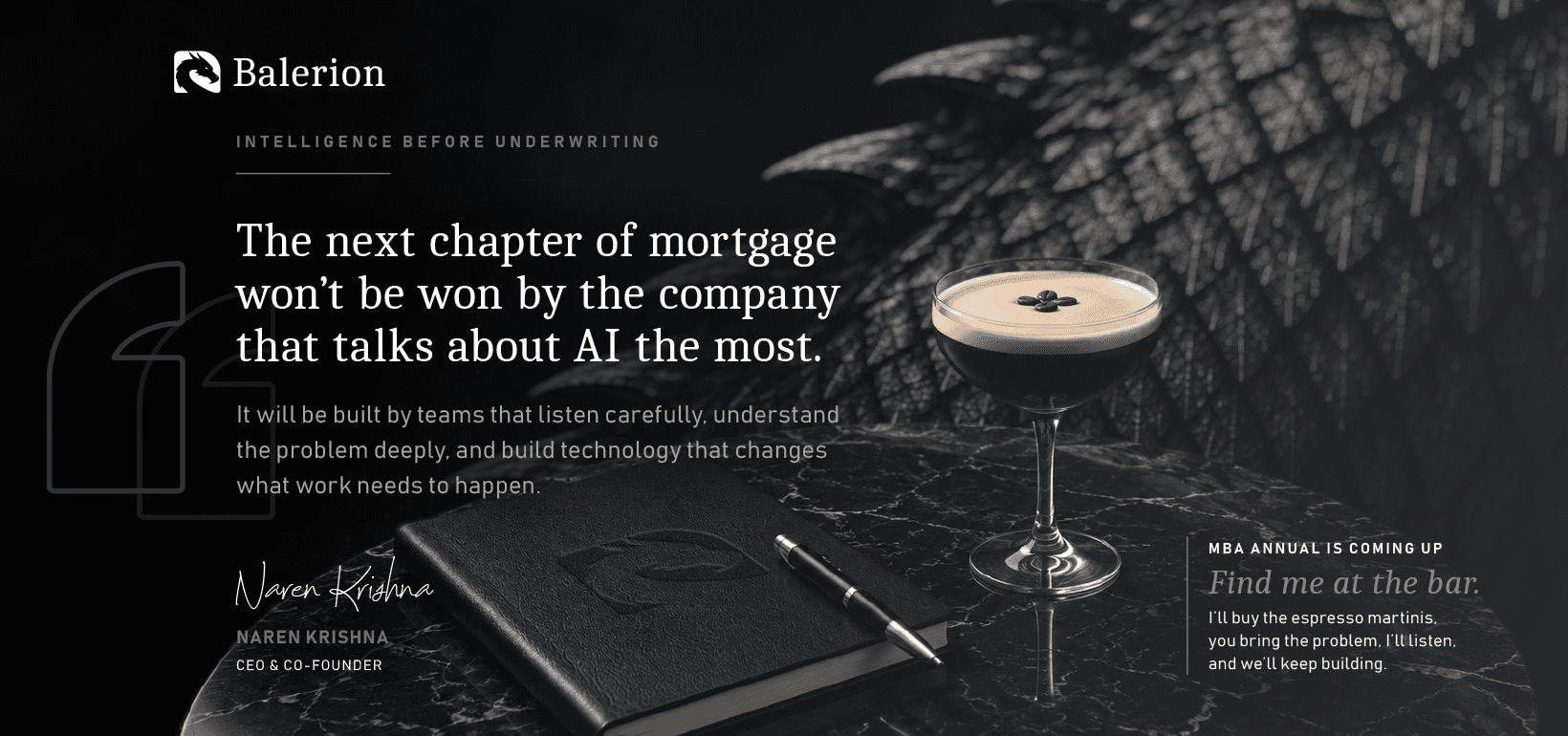
I’ll buy the espresso ma
rtinis. You bring the problem.
I’ll listen, and we’ll keep building.
